
Geo Investigation & Soil Testing
This activity performed by geotechnical engineers is to obtain information on the physical properties of soil by proper concerning test by the expertise staff.
Geo Investigation
An important basis for the planning and construction of building and infrastructure projects (comprising various types of structures as foundation, excavation pit, land reclamation, beach nourishment etc.) is the knowledge of the ground conditions. For this purpose, the geotechnical investigation with its respective services shall be carried out. Their nature and extent depends on the type of the structure, the difficulty of the structure and the expected ground conditions.
Geo technical engineering provides the following services to accomplish the geotechnical investigation tailor-made for each project:
- Data Collection.
- Geotechnical Investigation Programmed.
- Field Investigation and Sampling.
- Laboratory Testing.
- Geotechnical Investigation Report.
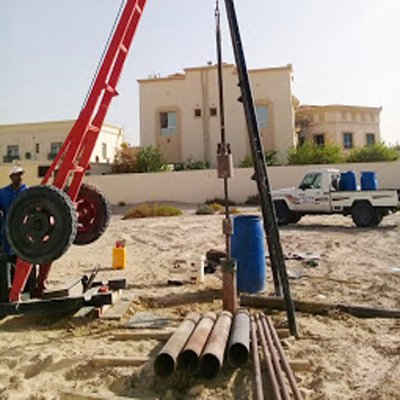
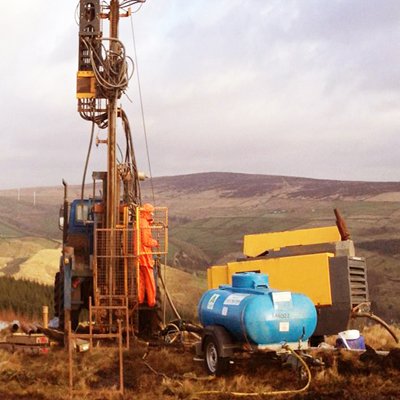
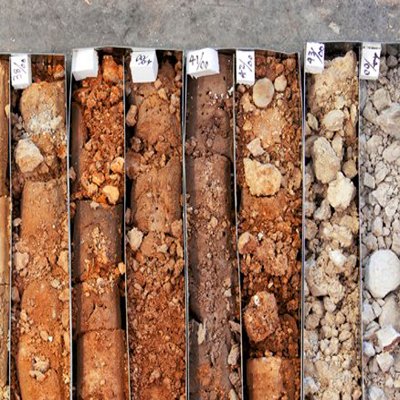
Standard Penetration Test (SPT)
Standard Penetration Tests (SPT) shall be performed in boreholes in order to estimate consistency, relative density, and strength-deformation parameters of soils. In addition to this soil samples obtained from SPT testing are used for classification purposes. SPT testing can also be carried out in weak weathered rock. The SPT testing shall be performed at certain numbers and respective intervals (it is common to apply an interval of 1.5m/test) to the borehole depth termination for all boreholes. The number of blows required to 15cm of penetration or fraction thereof is to be recorded. The first 15cm is to be considered as a seating drive. The number of blows required for the second and the third 15cm penetration is termed as "standard penetration resistance" or the raw "N value".
Field Vane Shear Test (VST)
Vane Shear Test (VST) is an in-place shear test in which a rod with thin radial vanes at the end is forced into the soil and the resistance to rotation of the rod is determined. VST addresses testing on land and for testing in drill holes or by self drilling or continuous push methods from the ground surface. VST provides an indication of in-situ undrained shear strength of fine-grained clays and silts or other fine geomaterials such as mine tailings, organic muck, and substances where undrained strength determination is required. Knowledge of the nature of the soil in which each vane test is to be made is necessary for assessment of the applicability and interpretation of the test. The test is not applicable for sandy soils which may allow drainage during the test. The test is routinely performed in conjunction with other field and laboratory tests.
Cone Penetration Test (CPT)
Cone penetration test (CPT) can be performed to evaluate effectively the site characterization. It is a valuable method of assessing the subsurface stratigraphy associated with soft materials, discontinuous lenses, organic soil, potentially liquefiable materials (silt, sands and granule gravel), generally excluding bedrock, very dense granular fill and strata containing cobbles and boulders. CPT is performed using a cylindrical penetrometer with a conical tip (cone) penetrating the ground at a constant rate. During the penetration, the forces on the cone and the friction sleeve are measured.
Index Property Test (Soil Classification)
The index property tests are performed for determining the soil classification:
- Moisture content — determination of the moisture content of a soil as a percentage of its oven-dried weight.
- Unit weight — determining the total/moist and dry densities — unit weights — of soil specimens.
- Specific gravity — determination of the specific gravity of soil solids passing the 4.75-mm sieve (No. 4) by means of a water pycnometer.
- Atterberg limits — determination of the liquid limit, plastic limit, and the plasticity index of soils.
- Particle size distribution — quantitative determination of the distribution of particle sizes in soils; distribution of particle sizes larger than 75 µm — retained on the No. 200 sieve — is determined by sieving, while the distribution of particle sizes smaller than 75 µm is determined by a sedimentation process, using a hydrometer.
Engineering Properties Tests
Engineering properties tests are performed for determining the strength and deformation parameters of soil:
- Unconfined compression strength — determination of the unconfined compressive strength of cohesive soil of the axial load.
Consolidation Test (One-Dimensional Consolidation Properties)
Determining the magnitude and rate of consolidation of soil when it is restrained laterally and drained axially while subjected to incrementally applied controlled-stress loading. Data from the consolidation test are used to estimate the magnitude and rate of both differential and total settlement of a structure or earth fill. Estimates of this type are of key importance in the design of engineered structures and the evaluation of their performance.
Consolidated Undrained Triaxial Compression Test
Determination of strength and stress-strain relationships of cohesive soil when the specimens are isotropically consolidated and sheared in compression without drainage at a constant rate of axial deformation. Data from the undrained triaxial compression test are used in geotechnical engineering analysis to predict how the material will behave in larger-scale geotechnical engineering applications. An example would be to predict the stability of the soil on a slope, whether the slope will collapse or whether the soil will support the shear stresses of the slope and remain in place. Undrained triaxial compression tests are used along with other tests to make such engineering predictions.
Rock Strength Properties Test
- Point load test — determining the point load strength index of rock. This is an index test and is intended to be used to classify rock strength.
- Uniaxial compression strength test — determining unconfined compressive strength of intact rock core specimens. It is a test method for compressive strength and elastic moduli of intact rock core specimens under varying states of stress and temperatures. Unconfined compressive strength of rock is used in many design formulas and is sometimes used as an index property to select the appropriate excavation technique.
Drilling Bore
Drilling bore (borehole drilling) is the primary field operation carried out to explore subsurface soil and rock conditions. Boreholes are advanced to the required depth using appropriate drilling techniques so that representative soil and rock samples can be collected, in-situ tests (SPT, VST, CPT) can be performed, and groundwater conditions can be recorded.
The method of drilling is selected based on the type of soil/rock, depth of investigation, and the purpose of the project. Drilling is carried out carefully to avoid disturbance of the in-situ soil strata and to maintain the natural moisture content of the samples.
Borehole drilling provides the following services:
- Rotary drilling for soil and rock strata.
- Auger drilling for shallow depth investigation.
- Wash boring in cohesionless soils.
- Collection of disturbed and undisturbed samples.
- Performance of in-situ tests (SPT, VST, CPT) within the borehole.
- Groundwater level monitoring and record keeping.
- Preparation of borehole logs and sub-surface profile.
The data obtained from borehole drilling forms the basis for the geotechnical investigation report and is essential for the safe and economical design of foundations and other structures.
Accreditation