
Geotechnical Site Investigation
Geotechnical site investigation is the primary phase of any construction project. It involves the systematic exploration of subsurface soil and rock conditions to obtain critical information for the design and construction of foundations, earthworks, and infrastructure projects.
The following services are included under geotechnical site investigation:
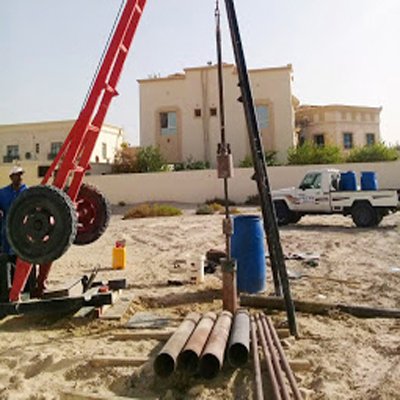
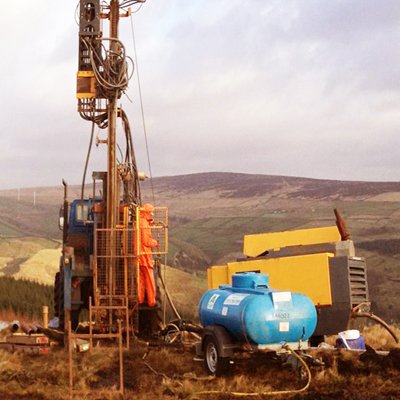
- Borehole Drilling — Advanced drilling techniques to explore subsurface soil and rock strata at required depths.
- Standard Penetration Test (SPT) — In-situ test to estimate consistency, relative density, and strength-deformation parameters of soils.
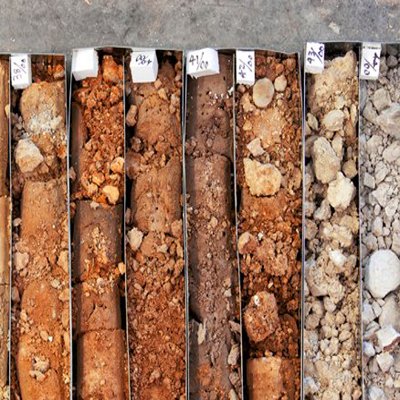
- Disturbed & Undisturbed Soil Sampling — Collection of representative soil samples for laboratory testing and classification.
- Field Density & Moisture Determination — On-site measurement of soil density and moisture content for quality control.
- Core Recovery & RQD — Assessment of rock quality through core recovery and Rock Quality Designation (RQD) measurements.
Site Testing
Field Testing for Earthworks & Foundations
Field testing is essential to verify the engineering properties of soil and rock in their natural state. These tests provide direct measurements that are used for design validation and construction quality control.
- Plate Load Test — Determines the ultimate bearing capacity and settlement characteristics of soil under foundation loading.
- Field CBR Test — Measures the California Bearing Ratio of subgrade soils for pavement and earthwork design.
- Field Density (Sand Replacement / Core Cutter) — In-situ determination of soil density for compaction control.
- Dynamic Cone Penetrometer (DCP) — Rapid assessment of in-situ soil strength and stratification.
Pile Foundation Testing
Pile foundation testing is performed to verify the load-carrying capacity and integrity of deep foundation elements. These tests ensure that the piles meet the design requirements and perform safely under service loads.
- Initial Load Test – Compression, Tension, Lateral — Comprehensive testing to determine pile capacity under different loading conditions.
- Routine Load Test — Regular load testing on production piles to confirm design assumptions.
- High-Strain Dynamic Testing (if applicable) — Dynamic testing to evaluate pile capacity and structural integrity.
- Pile Integrity Test — Non-destructive testing to detect defects, necking, or anomalies in pile shafts.
Bridge Load Testing
Bridge load testing is a critical evaluation method to assess the structural performance and load-carrying capacity of bridges. These tests are conducted to ensure the safety and serviceability of bridge structures.
- Static Load Test — Application of static loads to measure bridge deflection and structural response.
- Dynamic Load Test — Evaluation of bridge behavior under dynamic loading conditions.
- Structural Health Monitoring — Continuous monitoring of bridge integrity using advanced sensor technology.
Earth Resistivity Test
Earth resistivity testing is a geophysical method used to measure the electrical resistivity of soil and rock. This test is essential for earthing system design, corrosion assessment, and subsurface exploration.
The test provides valuable data for:
- Design of electrical earthing and grounding systems.
- Assessment of soil corrosivity for buried pipelines and structures.
- Subsurface stratification and groundwater investigation.
- Environmental and geotechnical site characterization.
Accreditation